
AI solutions for medical practices

Use AI where it removes real work.

MD Transform helps independent practices evaluate, integrate and adopt AI around clinical documentation, patient access, administrative workflow and secure information use.

Six practical AI capabilities for independent medical practices.

These capabilities address the clinical and administrative work consuming the most practice time. Each starts with the workflow rather than a preferred vendor. We evaluate every option for EHR fit, privacy, human review and measurable time recovered.

Physician using ambient AI documentation during a patient visit

01 · Ambient clinical documentation

AI Medical Scribes & Ambient Documentation

Compare and implement ambient AI that captures the visit, drafts structured notes and returns reviewed documentation to the EHR.

Read the 2026 market guide →
  • Reduce after-hours charting and note completion
  • Match specialty, language and EHR requirements
  • Measure edit burden, quality and time recovered
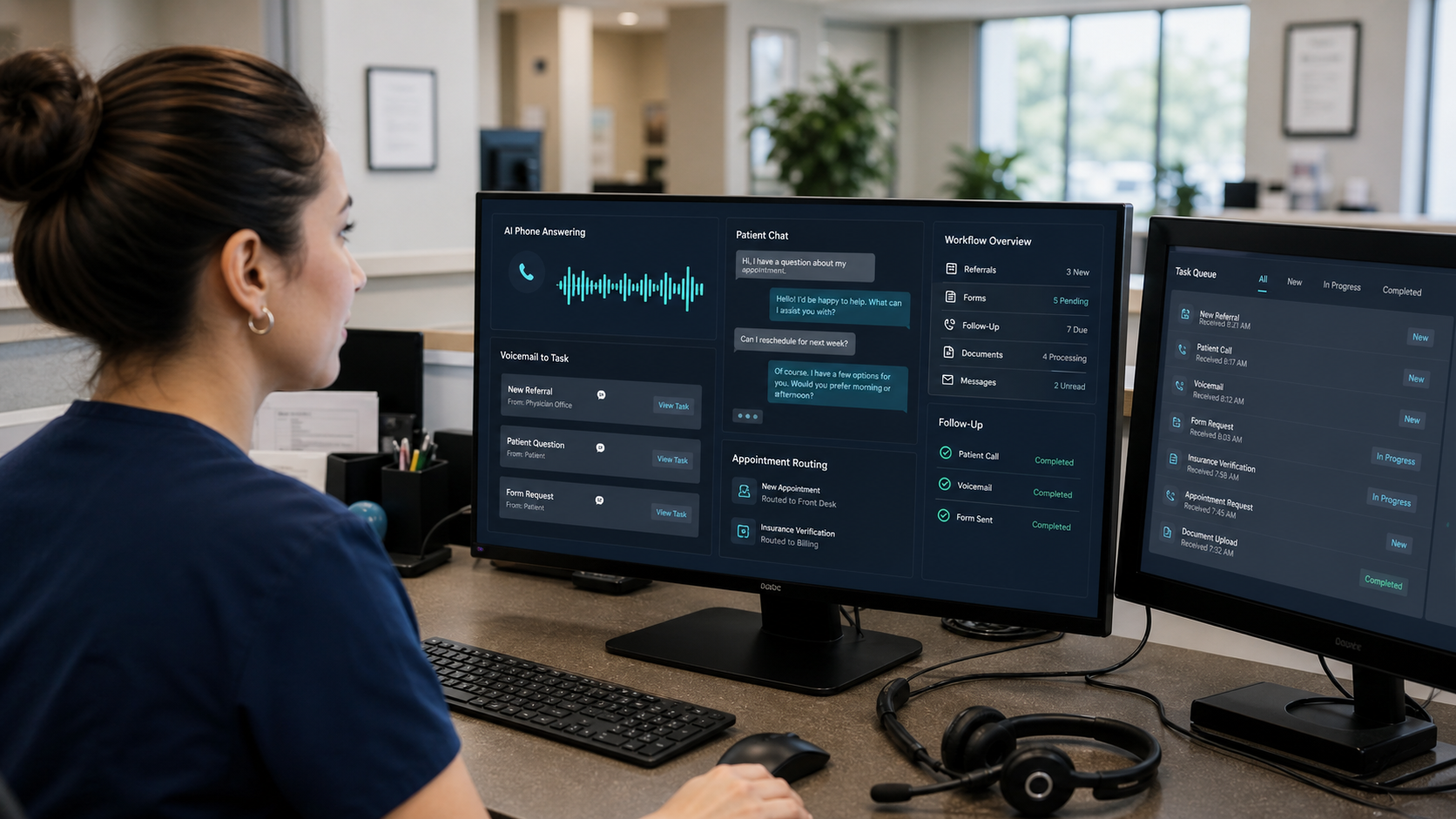
Medical front desk using AI for phone answering and patient communication

02 · Patient access

AI Phone Answering & Appointment Scheduling

Use healthcare-specific voice and chat agents for routine calls, patient verification, appointment booking, rescheduling and human handoff.

Read the 2026 market guide →
  • Answer routine calls and manage appointments
  • Verify patient identity and collect required information
  • Route clinical, urgent and complex requests to staff
Medical practice authorization team reviewing insurance eligibility and prior authorization work queues

03 · Insurance operations

AI Insurance Eligibility & Prior Authorization

Automate coverage checks, benefit verification and prior authorization preparation while keeping staff in control of exceptions and submissions.

Read the 2026 market guide →
  • Run real-time eligibility and benefit checks
  • Gather payer rules and required clinical documentation
  • Track exceptions, status and staff follow-up
Physician and medical coding specialist reviewing AI-assisted coding and revenue cycle information

04 · Revenue cycle

AI Medical Coding & Revenue Cycle Automation

Use documentation-aware AI to suggest or automate ICD-10, CPT and E/M coding, detect missing information and shorten claim turnaround.

Read the 2026 market guide →
  • Support or automate coding by service line
  • Identify documentation gaps before claim submission
  • Reduce preventable denials and manual rework
Medical assistant and clinician using AI to triage patient messages and prepare chart summaries

05 · Clinical inbox

AI Patient Messages, Chart Summaries & Instructions

Draft portal replies, summarize charts and produce patient instructions or translations for clinician review.

Read the 2026 market guide →
  • Draft and route patient portal messages
  • Summarize charts for visits, referrals and handoffs
  • Create reviewed instructions and translations
Clinicians using AI research tools to review cited medical evidence and clinical guidance

06 · Clinical knowledge

AI Clinical Research & Decision Support

Give clinicians cited access to current medical evidence and patient-specific context without replacing professional judgment.

Read the 2026 market guide →
  • Search guidelines and medical literature with citations
  • Summarize evidence for care planning and referrals
  • Keep clinical judgment and final decisions with clinicians

The right solution earns its place in the workflow.

01

Meaningful time saved

The solution should remove work from physicians or staff, not simply move it to a different screen.

02

Fits existing systems

We consider EHR compatibility, handoffs, security and the real constraints of an independent practice.

03

Clinicians stay in control

AI should support judgment and execution while keeping clinical decisions with qualified people.

Not sure which solution belongs first?

Explore the On-Site Assessment